Excellent tutorial on how to SCRoG & other links to training techniques
By far the best tutorial on scrog and other techniques to training like LST, SOG, FIM, etc. It even has solutions to common problems and give great examples on things to think about before you set up.
Scrog gives you double the yield in comparison to natural methods by creating an even carpet of green buds so all bud sites are getting an equal amount of light so no more popcorn larfy buds!
Monday, March 10, 2014

Friday, March 7, 2014
Potency, THC, CBD, CBN, and Harvesting Methods to Produce the Type of "High" You Prefer
I'm pretty much a fan of "couch lock" cannabis and don't really like the trippy, creative, high some strains can give you. I smoke pot because I want to relax; not be energetic haha! I also really enjoy the pain relieving qualities some strains can give you but have never really understood how it all works. GrowWeedEasy.com had a great article with links for further reading here:
and of course a copy/paste in case the link won't work ;)
THC, CBN and CBD: What Every Grower Needs to Know
by Nebula Haze
Recently, I've been doing a lot of research on cannabinoids (the stuff in marijuana buds that makes these particular flowers so special).
Skip the theory and jump down to the practical step-by-step instructions

I am dedicated to getting you the best and latest information, in a simple, easy-to-understand format, so you can grow marijuana that fits your needs.
Today I will share you what I've learned about the 3 main cannabinoids that we know the most about in marijuana, THC, CBN and CBD.
Chances are, you've heard of THC (delta9-tetrahydrocannabinol), one of the main components of marijuana that causes its unique mind-altering effects on humans.
Not too long ago, we thought that THC was the main cannabinoid that affected the "potency" and effects produced by marijuana.
However, in addition to THC, there are many other cannabinoids found in marijuana, including CBD, CBN, CBC, CBG, THCV, and many others.

Did you know?
Prescription drug Sativex has been created which contains 50% each of THC and CBD derived directly from a marijuana plant.
Sativex appears to be very well tolerated and doesn't have many of the side effects associated with Marinol, which is made of 100% THC.
We've learned that, while THC is likely responsible for many the pain relieving (and more trippy) effects of marijuana, we also need to study the effects the other cannabinoids have on our health and how we feel after using marijuana.
Now some people love high THC levels and don't need or want any of the other cannabinoids. For other people, the positive effects of THC are only felt when enough other cannabinoids are present, too.
THC, CBD and CBN are the most studied cannabinoids found in high levels in marijuana. By understanding the simple relationship between these three cannabinoids, you can tune your grow into your unique needs.
THC / CBN / CBD Rundown (the Science)
The Truth About THC (delta9-tetrahydrocannabinol)
THC mimics the action of anandamide, which is a naturally occurring cannabinoid in the brain.
Now, THC is the main psychoactive component in marijuana buds.
Quick Summary of THC
In fact, the following negative effects of THC are often prevented when higher levels of CBD or CBN are present:
Quick Summary of CBN
Quick Summary of CBD
CBD appears to:
Answer to Common Question: What does it mean when marijuana buds are "18.2%" THC, "0.1%" CBN and "0.5%" CBD?

It means that of all the cannabinoids present in the sample, 18.2% of them are THC, 0.1% of them are CBN and 0.5% of them are CBD.
What does this mean to you? It means having a lot of trichome production does not necessarily mean higher potency. The resins inside the trichome may or may not contain high levels of active ingredients.
Another thing to keep in mind is that these numbers do not in any way indicate "weight by volume." In other words, sometimes two samples of weed can have the same numbers, and can have similar effects, but one sample could be way stronger because it has higher levels of cannabinoids overall.
and of course a copy/paste in case the link won't work ;)
THC, CBN and CBD: What Every Grower Needs to Know
by Nebula Haze
Recently, I've been doing a lot of research on cannabinoids (the stuff in marijuana buds that makes these particular flowers so special).
Skip the theory and jump down to the practical step-by-step instructions
I am dedicated to getting you the best and latest information, in a simple, easy-to-understand format, so you can grow marijuana that fits your needs.
Today I will share you what I've learned about the 3 main cannabinoids that we know the most about in marijuana, THC, CBN and CBD.
Chances are, you've heard of THC (delta9-tetrahydrocannabinol), one of the main components of marijuana that causes its unique mind-altering effects on humans.
Not too long ago, we thought that THC was the main cannabinoid that affected the "potency" and effects produced by marijuana.
However, in addition to THC, there are many other cannabinoids found in marijuana, including CBD, CBN, CBC, CBG, THCV, and many others.
Did you know?
Prescription drug Sativex has been created which contains 50% each of THC and CBD derived directly from a marijuana plant.
Sativex appears to be very well tolerated and doesn't have many of the side effects associated with Marinol, which is made of 100% THC.
We've learned that, while THC is likely responsible for many the pain relieving (and more trippy) effects of marijuana, we also need to study the effects the other cannabinoids have on our health and how we feel after using marijuana.
Now some people love high THC levels and don't need or want any of the other cannabinoids. For other people, the positive effects of THC are only felt when enough other cannabinoids are present, too.
THC, CBD and CBN are the most studied cannabinoids found in high levels in marijuana. By understanding the simple relationship between these three cannabinoids, you can tune your grow into your unique needs.
THC / CBN / CBD Rundown (the Science)
The Truth About THC (delta9-tetrahydrocannabinol)
THC mimics the action of anandamide, which is a naturally occurring cannabinoid in the brain.
Now, THC is the main psychoactive component in marijuana buds.
Quick Summary of THC
- THC seems to provide certain positive health benefits, especially when combined with other cannabinoids
- THC has the strongest psychoactive effects
- THC can cause feelings of creativity, curiosity, or excited well-being
- High THC levels may cause people to feel anxious, disorientated, drugged or "messed up"
- Relieve Certain Types of Pain
- Be Neuroprotective (helps stop brain from degenerating over time)
- Cause Relaxation
- Cause Euphoria
- Contribute to Altered Space-Time Perception
- Stimulate Appetite
- THC levels in buds are determined mostly by strain (genetics). Choose a high-THC strain to get the highest levels of THC
- THC is found primarily in trichomes on marijuana buds and (for some strains) on leaves, stems, and other parts of plant
- Increasing overall resin production in a high-THC strain will usually increase your overall THC levels
- Harvesting when trichomes are milky white or cloudy with just a few amber trichomes starting to appear will result in highest levels of THC
In fact, the following negative effects of THC are often prevented when higher levels of CBD or CBN are present:
- Lapses in Memory
- Disorientation
- Anxiety
Quick Summary of CBN
- CBN is also psychoactive, though much less so than THC
- The presence of CBN with THC seems to reduce the feelings of anxiety that some people feel with high levels of THC
- The presence of higher levels of CBN with THC can cause people to feel less "messed up" from exposure to THC
- Too much CBN can make people feel groggy or sleepy
- Therefore, CBN promotes uninterrupted sleep
- THC turns into CBN when exposed for long periods to air or UV light
- CBN levels in buds can be influenced by harvest, drying, and curing methods
- Waiting longer to harvest, until trichomes have turned amber, often results in higher CBN levels
- Higher exposure to air during drying/curing, and longer curing processes result in higher levels of CBN
Quick Summary of CBD
- CBD is not psychoactive
- CBD seems to have many positive health implications
- Like CBN, the presence of CBD can reduce some of the subjective effects of THC
- A 2010 study indicated that marijuana buds which are high in CBD prevents the memory impairment caused by high-THC levels
CBD appears to:
- Prevent Convulsions
- Relieve Some types of Inflammation
- Reduce Anxiety
- Relieve Nausea
- Reduce Insomnia
- Have a calming effect
- Act as an antipsychotic for people suffering from schizophrenia
- Possibly offer relief for those suffering from Multiple Sclerosis, Fibromyalgia and Epilepsy
- Help stop the growth of cancer by inhibiting cancer cell growth, for example when injected into breast and brain tumors in combination with THC
- Prevent the memory impairment and disorientation associated with THC
- Like THC, CBD content in buds is primarily determined by strain (genetics)
- CBD is often confused with CBN, which can be affected by harvest methods
- There is not much you can do to increase levels of CBD besides choosing a high CBD strain
- CBD is naturally found in higher amounts in low-THC varieties such as Hemp and Ruderalis (auto-flowering)
- In recent years, some high-THC strains have been particularly bred for higher levels of CBD
Answer to Common Question: What does it mean when marijuana buds are "18.2%" THC, "0.1%" CBN and "0.5%" CBD?
It means that of all the cannabinoids present in the sample, 18.2% of them are THC, 0.1% of them are CBN and 0.5% of them are CBD.
What does this mean to you? It means having a lot of trichome production does not necessarily mean higher potency. The resins inside the trichome may or may not contain high levels of active ingredients.
Another thing to keep in mind is that these numbers do not in any way indicate "weight by volume." In other words, sometimes two samples of weed can have the same numbers, and can have similar effects, but one sample could be way stronger because it has higher levels of cannabinoids overall.
So tell me, which is better, THC, CBN or CBD?
As a grower, you will get the best results when you choose a specific strain and prepare your plants in order to specifically cause the effects you're looking for.
The best results seems to come from using marijuana that has a mix of cannabinoids that are suited to your needs.
The information you've learned today has given you a great foundation to understand the effects you're getting with different buds.
For example, high-THC strains have many positive benefits, yet too much THC by itself, without other cannabinoids like CBD and CBN, can cause disorientation, lapses in memory and anxiety.
For those who find these effects unpleasant, choosing strains with higher levels of CBD, or using harvest and curing methods that promote the creation of CBN often prevent many of these negative side effects.
In other words, the levels you want of THC, CBD, and CBN are truly a matter of personal preference.
3 Steps to Controlling THC, CBD, and CBN levels in your marijuana buds
1.) Pick Your Strain (genetics play a big factor for THC and CBD)
If you've grown a few different strains before, you probably already realize that the genes of your plants plants play a big role in the results of your marijuana grow.
When it comes to influencing your levels of THC and CBD, the strain you start with is basically the most important factor.
Genetics largely determine the amounts of THC and CBD produced in your buds.
Remember: Unlike THC and CBD discussed in this step, the most practical way to control CBN levels is using the correct harvest, drying, and curing methods. We'll discuss these in a moment.
Because genes determine many of the cannabinoids levels, for best results you must find a strain which has the effects you are seeking.
Looking for marijuana strains with high THC levels?
THC levels are commonly bragged about. THC is the most psychoactive component of marijuana buds.
Many of the more famous, "ultra-potent" strains are high-THC (low CBD) strains, as well as most pure Sativas.
Looking for marijuana strains with high CBD levels?
Strains with "Afghan" or "Afghani" lineage tend to have higher levels of CBD, as do most non-psychoactive varieties like Ruderalis (auto-flowering) and hemp.
Afghan strains are potent and easy to grow, generally have high CBD content and produce great yields. Therefore strains with Afghan lineage are usually a great choice for beginning growers looking for a marijuana strain with higher levels of CBD.
Ruderalis (auto-flowering) plants are high-CBD yet stay very tiny, so are only recommended for stealth grows or those looking for small amounts of medicine.
2.) Harvest At the Right Time (plays a factor for THC and CBN)
While you cannot control CBD levels with harvest methods, you can influence the the amount of THC and CBN in your buds by choosing the right time to harvest your plant.
CBD levels seem to remain relatively stable for most of the harvesting period.
Pick the right time to harvest by watching:
This is the simplest harvest method. Watch the pistols/hairs growing on the buds and harvest based on how many have darkened and curled in.
For the marijuana scientist, watching the trichomes gives you a bit more insight into what's going on with your plant's cannabinoinds.
Plus it's really fun to look at trichomes through a jeweler's loupe or microscope.
There is a lot of variation between strains and people's preferences, so it is highly recommended you experiment with your plants to see what works best for you.
Important Tip: Exact harvest time isn't as critical as we once thought.
Don't stress too much, often buds have similar levels of cannabinoids even when harvested weeks apart.
How do I experiment with harvest time if I only grow 1 or 2 plants?
It is totally okay to harvest different parts of your plants at different times.
Just make sure there is enough green foliage left to support the plant.
Some growers say that harvesting different parts of the plant at different times is stressful for the plant, and that is true.
It's also been shown that stress near harvest time actually causes an increase in resin/cannabinoid production, which most growers find beneficial.
While you're in the harvest window, your plant puts all her effort into making the most awesome buds possible.
As long as you have a healthy plant, I highly recommend harvesting different parts of the plant at different times to (labeling them so you remember which one you harvested when!) and find out what works best for you.
Learn more about when to harvest marijuana here (more pictures)
3.) Dry and Cure Buds Properly
Most growers agree that drying buds slowly and then curing buds in an air-tight space improves the taste and smell of buds.
Many growers also agree that curing your marijuana buds for 2-4 weeks or longer actually seems to increase the subjective potency of buds.
Curing buds for a longer period causes some of the THC to turn into CBN, which happens as the THC is exposed to air.
Some people also speculate that having a bit of CBN helps "activate" THC effects.
Whether it's because of this process or or something else, curing marijuana buds has an effect on potency, in addition to improving the taste and smell.
Curing for too long (over 6 months) does not continue to cause any increase in potency. Buds actually start getting less potent as much of the THC degrades.
You can safely store buds longer when marijuana is kept in a dark, cool, dry airtight environment.
Remember: marijuana buds should always be dry prior to any kind of long-term storage, and you may have dry them again if you store them somewhere that has high humidity.
Learn more about curing marijuana here
About Nebula Haze and Her Love of Cannabinoids
I personally use cannabis for the treatment of anxiety, and to prevent seizures. I like to have slightly higher CBD and CBN levels in my buds. Because of this, I tend to choose higher-CBD strains, harvest later and cure buds longer.
On the other hand, I know many growers who prefer cannabis with high THC and low CBD and CBN levels because the result can be more 'up' or 'trippy.' These growers choose low CBD strains and tend to harvest their buds several weeks earlier than I would.
We both love the buds we grow.
To see what suits you best, I strongly recommend personal experimentation with strains, harvest times, and curing length.
This is one of the best aspects of growing your own weed, you can choose to produce buds that do exactly what you want.
Now everyone's individual experience is going to be different, there's no one-size-fits-all.
Yet now you have something most other growers don't; you are armed with the knowledge you need to tune into your own perfect grow.
As a grower, you will get the best results when you choose a specific strain and prepare your plants in order to specifically cause the effects you're looking for.
The best results seems to come from using marijuana that has a mix of cannabinoids that are suited to your needs.
The information you've learned today has given you a great foundation to understand the effects you're getting with different buds.
For example, high-THC strains have many positive benefits, yet too much THC by itself, without other cannabinoids like CBD and CBN, can cause disorientation, lapses in memory and anxiety.
For those who find these effects unpleasant, choosing strains with higher levels of CBD, or using harvest and curing methods that promote the creation of CBN often prevent many of these negative side effects.
In other words, the levels you want of THC, CBD, and CBN are truly a matter of personal preference.
The Practical Stuff: What You Need to Do as a Grower to Control Cannabinoid Levels in Your Marijuana Buds
Now we're going to jump into the practical and show you exactly what you need to know so you can control the levels of each of these 3 cannabinoids in the marijuana buds you grow.3 Steps to Controlling THC, CBD, and CBN levels in your marijuana buds
1.) Pick Your Strain (genetics play a big factor for THC and CBD)
If you've grown a few different strains before, you probably already realize that the genes of your plants plants play a big role in the results of your marijuana grow.
When it comes to influencing your levels of THC and CBD, the strain you start with is basically the most important factor.
Genetics largely determine the amounts of THC and CBD produced in your buds.
Remember: Unlike THC and CBD discussed in this step, the most practical way to control CBN levels is using the correct harvest, drying, and curing methods. We'll discuss these in a moment.
Because genes determine many of the cannabinoids levels, for best results you must find a strain which has the effects you are seeking.
Looking for marijuana strains with high THC levels?
THC levels are commonly bragged about. THC is the most psychoactive component of marijuana buds.
Many of the more famous, "ultra-potent" strains are high-THC (low CBD) strains, as well as most pure Sativas.
Looking for marijuana strains with high CBD levels?
Strains with "Afghan" or "Afghani" lineage tend to have higher levels of CBD, as do most non-psychoactive varieties like Ruderalis (auto-flowering) and hemp.
Afghan strains are potent and easy to grow, generally have high CBD content and produce great yields. Therefore strains with Afghan lineage are usually a great choice for beginning growers looking for a marijuana strain with higher levels of CBD.
Ruderalis (auto-flowering) plants are high-CBD yet stay very tiny, so are only recommended for stealth grows or those looking for small amounts of medicine.
2.) Harvest At the Right Time (plays a factor for THC and CBN)
While you cannot control CBD levels with harvest methods, you can influence the the amount of THC and CBN in your buds by choosing the right time to harvest your plant.
CBD levels seem to remain relatively stable for most of the harvesting period.
Pick the right time to harvest by watching:
- Pistils ("white hairs" that grow from new buds)
- Trichomes (crystals or resin glands, the glittery stuff on your marijuana buds)
This is the simplest harvest method. Watch the pistols/hairs growing on the buds and harvest based on how many have darkened and curled in.
- For a speedier high, harvest when about 40% of white hairs have darkened and curled in
- For highest THC levels and buds that make you soar, wait until buds have fattened and 50-70% of the white hairs have darkened and curled in.
- For higher CBN levels, which cause more of a relaxing effect, wait until new white hairs stop growing, and 80-90% of the hairs have darkened and there are few white hairs.
For the marijuana scientist, watching the trichomes gives you a bit more insight into what's going on with your plant's cannabinoinds.
Plus it's really fun to look at trichomes through a jeweler's loupe or microscope.
- Early on, when there are still many clear trichomes, buds tends to produce a heady, wired kind of high. THC levels are lower at this point, though they're ramping up each day.
- For highest THC levels, harvest when nearly all the clear trichomes have turned milky white. This will produce buds with the most mind-altering effects.
- For a more relaxing effect, wait to harvest until many of the milky white trichomes have darkened to amber/gold. These amber trichomes have a bit less THC, but more CBN. The presence of CBN often reduces the anxiety some people feel from high THC levels.
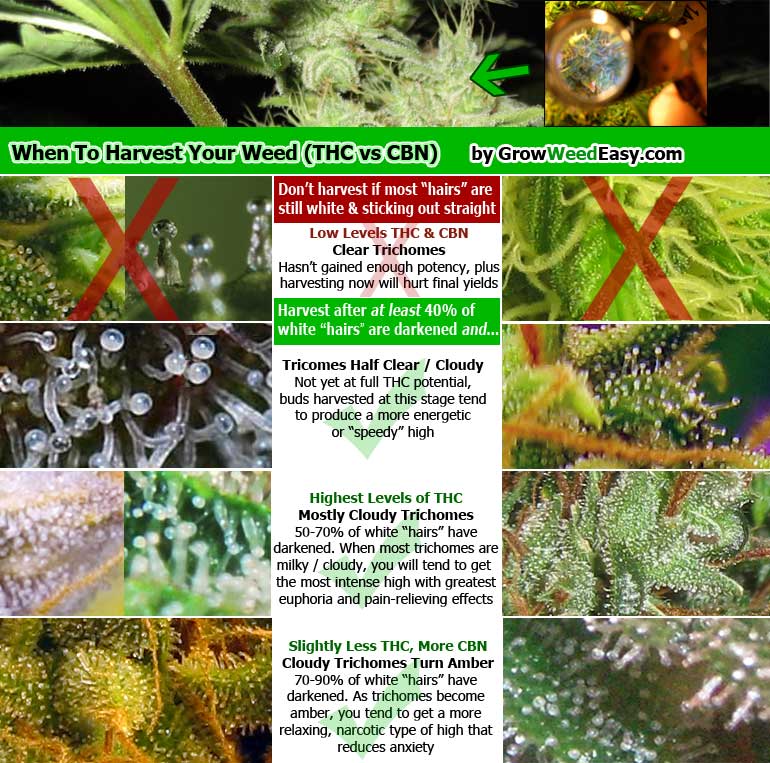
There is a lot of variation between strains and people's preferences, so it is highly recommended you experiment with your plants to see what works best for you.
Important Tip: Exact harvest time isn't as critical as we once thought.
Don't stress too much, often buds have similar levels of cannabinoids even when harvested weeks apart.
How do I experiment with harvest time if I only grow 1 or 2 plants?
It is totally okay to harvest different parts of your plants at different times.
Just make sure there is enough green foliage left to support the plant.
Some growers say that harvesting different parts of the plant at different times is stressful for the plant, and that is true.
It's also been shown that stress near harvest time actually causes an increase in resin/cannabinoid production, which most growers find beneficial.
While you're in the harvest window, your plant puts all her effort into making the most awesome buds possible.
As long as you have a healthy plant, I highly recommend harvesting different parts of the plant at different times to (labeling them so you remember which one you harvested when!) and find out what works best for you.
Learn more about when to harvest marijuana here (more pictures)
3.) Dry and Cure Buds Properly
Most growers agree that drying buds slowly and then curing buds in an air-tight space improves the taste and smell of buds.
Many growers also agree that curing your marijuana buds for 2-4 weeks or longer actually seems to increase the subjective potency of buds.
Curing buds for a longer period causes some of the THC to turn into CBN, which happens as the THC is exposed to air.
Some people also speculate that having a bit of CBN helps "activate" THC effects.
Whether it's because of this process or or something else, curing marijuana buds has an effect on potency, in addition to improving the taste and smell.
Curing for too long (over 6 months) does not continue to cause any increase in potency. Buds actually start getting less potent as much of the THC degrades.
You can safely store buds longer when marijuana is kept in a dark, cool, dry airtight environment.
Remember: marijuana buds should always be dry prior to any kind of long-term storage, and you may have dry them again if you store them somewhere that has high humidity.
Learn more about curing marijuana here
About Nebula Haze and Her Love of Cannabinoids
I personally use cannabis for the treatment of anxiety, and to prevent seizures. I like to have slightly higher CBD and CBN levels in my buds. Because of this, I tend to choose higher-CBD strains, harvest later and cure buds longer.
On the other hand, I know many growers who prefer cannabis with high THC and low CBD and CBN levels because the result can be more 'up' or 'trippy.' These growers choose low CBD strains and tend to harvest their buds several weeks earlier than I would.
We both love the buds we grow.
To see what suits you best, I strongly recommend personal experimentation with strains, harvest times, and curing length.
This is one of the best aspects of growing your own weed, you can choose to produce buds that do exactly what you want.
Now everyone's individual experience is going to be different, there's no one-size-fits-all.
Yet now you have something most other growers don't; you are armed with the knowledge you need to tune into your own perfect grow.
Thursday, March 6, 2014
Wednesday, March 5, 2014
Sunday, March 2, 2014
Outdoor Cannabis Planting Guide by zone/location using Google Maps
This handy dandy tool lets you use latitude/longitude coordinates or you can even use their link to google maps to find when to plant your cannabis and it even suggest strains hardy to your specific location. glad I took a look before my plants went into bloom instead of veg like I thought. I took a Pit Bull indica strain out of my ebb and flow table since it's fussy about nutes and planted it in Fox Farm's Ocean Forest mixed with perlite. When I was talking to the short ginger hippie guy at the hydro store, one other person came in to buy several bags of it as well so I know what I'm hearing is correct; it's good shit.
http://en.seedfinder.eu/research/climate/
http://en.seedfinder.eu/research/climate/
Soil Mix Recipe for Cannabis JUST ADD WATER!!!
updated info: http://whattheladieswantaladiesgrowblog.blogspot.com/2014/04/subcool-super-soil-recipe-with.html
Super soil recipe WITH ADDITIONAL ONFO REGARDING BLOOM
http://growdesignconsign.tumblr.com/post/40276679466/lets-talk-about-super-soil-and-tga-growing-methodology
I found this great article featuring Subcool's soil mix recipe as featured in Cannabis Culture where all you have to do is just add water and follow the directions for building the super soil for the bottom portion of the container with a base soil like Roots Organics for around the plant. The idea is that you just water the plant and the roots will grow down into the super soil to feed where all the nutrients the plant will ever want will be attainable. I've got a plant that is so finicky in my ebb and flow table that I have decided to replant it in soil and stick it next to my flood table under my metal halide. Soil is forgiving and I 'm hoping that the Pit Bull indica will be more happy. It grew twice as big as my other plants that are healthier but it's leaves show signs of yellowing burn and also purple tips with a mosaic purple pattern that is very slowly getting worse; hence the "abort hydro mission".
Here is a link to the article for the recipe I'm planning on imitating. I don't need that much soil so to buy each item individually is more money for a lousy 5 gallon pot. I'm thinking I will use Fox Farms Ocean Forest as my super soil with the roots organics as a top soil. Ocean Forest is amazingly packed with nutrients that it has been known to cause burn so it was suggested to be watered down. I'm thinking I will then put that in the bottom of the bucket about 30% then put a few inches of Roots before I place the root ball as a buffer. Then add Roots to the sides and top to fill container. I also thought I might keep it in the gallon hydro net pot filled with clay pellets instead of adding extra hydrocorn to my soil for aeration (save $$ and less transplant shock hopefully due to oxygen all around root base). Fox Farms states that with their soils you just need to add Big Bloom fertilizer for bloom period (0.01-0.03-0.07 NPK). Sounds easy enough! Fingers Crossed!!!!
If you don't wanna follow the link then here is a copy paste:
To me there is nothing like the flavor of properly grown organic cannabis. The subtle flavors and aromas created when using mother earth is over whelming to the senses when done properly.
As with many vegetables a rich Organic soil can bring out the best in a plant. Over the past 20 years I have tried almost every possible way to cultivate our favorite plant and while hydro is certainly faster and the yields blow soil away, I have developed a soil that performs extremely well and there’s very little guess work. I don’t worry about ph or ppm I simply have spent a few years developing a sound recipe and in combination with 7 gallon nursery pots I can run from start to finish using only water. Other than a bit of sweat equity every 90 days or so it takes a huge amount of science out of the garden and puts nature back in charge. This recipe is slightly different from my last and from the one so many use as gospel that I have passed around for years from grower to grower.
I always start with at least 6-8 large bags of high quality organic soil. The selection of your base soil is very important so don’t cut corners here. I cannot begin to discuss all the different products but I will discuss a few in this article. A good Organic soil should cost between 8-10$ per 30# bag. I want you to get a real good idea what I consider a balanced soil to be so take a look at the ingredients of a product called Roots Organic:
 Lignite*, coca fiber, perlite, pumice, compost, peat moss, bone meal, bat guano, kelp meal, Green sand, soy bean meal, leonardite, k-mag, glacial rock dust, alfalfa meal, oyster shell flour, earth worm castings and Mycorrhizae.
I have always believed in giving my plants a wide range of soils and additives I figure it’s like a buffet they get all they need
“Lignite, also known as leonardite, mined lignin, brown coal, and slack, is an important constituent to the oil well, drilling industry. Lignite, or leonardite as it will be referred as hereafter, is technically known as a low rank coal between peat and sub-bituminous. Leonardite was named for Dr. A.G. Leonard, North Dakota’s first state geologist, who was a pioneer in the study of lignite deposits. Leonardite is applied to products having a high content of humic acid. Humic acid has been found to be very useful as a drilling mud thinner.”
Another local product we are trying now is called Harvest Moon.
Washed coco fibers, Alaskan peat moss, perlite, yucca, pumice, diatoms, worm castings, feather meal, fishmeal, kelp meal, limestone, gypsum, soybean meal, alfalfa meal, rock dust, yucca meal, and Mycorrhizae fungi.
The Roots produced a more floral smell in the finished flowers while the Harvest Moon generated larger yields.
 If you have access to a good local mix like these then I highly recommend starting with these type products. We have also had decent results using commercial brands as well but not as is. The best results we have seen from well known soil that is available nationwide is Fox Farms “Ocean Forrest” soil combined in a 2-1 ratio with Light Warrior. On it’s own the Ocean Forrest is known for burning plants and having the wrong ratio’s of nutrients but when cut down with Light Warrior it makes a pretty good mix for a base soil.
You can also just use 2 bales of Sunshine mix #4 but this is my last choice and plants growing in this may not complete properly with this “Just add water” method of soil growing. The concept to this concentrated soil is to not have to worry with mixing up nutrients after the soil is made. The concentrate is placed in the bottom ¼ to ½ of the container and blended with base soil. This allows the plants to grow into the strong concentrated soil and in the right size container need nothing else but water throughout the full harvest cycle. With strains requiring high levels of nutrients we go as strong as ¾ of the container with Super Soil but this is only with a small percentage of strains.
Here are the amounts we have found that produce the best tasting buds and strongest medicines.
8- Large bags of High quality Organic potting soil with a coco and Mycorrhizae
1- 25-50 pounds of Organic Worm castings
5 lb. Steamed Bone meal
5 lb. Bloom bat Guano
5 lb. Blood meal
3 lb. Rock Phoshate
¾ cup Epson salts
½ to 1 Cup cup Sweet Lime ( Dolimite)
½ Cup Azomite ( Trace Elements)
2- TBS Powdered Humic Acid
 This is the same basic recipe I have used for 15 years the hardest ingredient to acquire is the worm castings most people don’t even know what it is. Be resourceful and find it worms make up ¾ of the living organisms underground btw and hold our planet together.
Be careful not to waste money on Soil Conditioner with worm casting but local Pure Worm poop with no added mulch.
There are several methods of mixing this up well.
You can sweep off a patio or garage and work there on a tarp.
You can use a kids plastic wading pool these cost about 10$ and work really well for a few seasons.
Some growers have been known to rent a cement mixer and cut down on the physical labor. As long as you get the ingredients mixed up properly that is all that matters.
This can be a lot of work so don’t pull a muscle if your not used to strenuous activity. This method is good for mind and body. Working with soil keeps me in pretty good shape, but if you have limitations you can simply have someone mix it up for you while you supervise. One of the things I like about this method is I can drop of plants to a patient and all they have to do is water the plants when the soil dries out.
Place a few bags of base soil in first making a mound. I then place the powdered nutrients in a circle around the mound and then cover with another bag of base soil.
 Then goes in the bat poop and then more base soil. I continue to layer soil and additives until everything has been added to the pile. So now I put on the muck boots, these help me kick the soil around and get it mixed up well using my larger leg muscles and not my back and arms. Then it’s as simple as my Skipper used to say “ Put your back into it”. This is hard work that I obsess on, even breaking up all the clods of soil by hand. I mix for about 15 minutes, turning the pile over and over until it is mixed well. I store the mix in large garbage cans. Before using the mix the entire load is poured out once more and mixed well. Once placed in the containers I water it slightly adding 3 gallons of water to a large garbage can full. It will make the stirring harder next week but it will activate the Mycorrhizae and I think help all the powders dissolve.
So now we add water and let it cook in the sunshine. 30 days is best for this concentrate.
Do not put seeds or clones directly in this mix. It is an advanced mix used in conjunction with base soil. It is used to place in the bottom of each finishing container and fully rooted established clones are placed in a bed of base soil that is layered on top of the concentrate. As the plants grow they slowly push their roots into the super soil drawing up all nutrients needed for a full cycle. The Super Soil can be used also to top dress plants that take longer to mature.
 I will use this mix for a full year just adding like 30-50% in the lower potion of the container and plain base soil in the top portion.
Base Soil means your regular potting soil Like Roots, Harvest Moon, or even sunshine mix without the additives!
Buds from this method finish with a fade and a smoother fruity flavor. The plants are not green when done but Purple, Red, Orange and even Black at times. The resin content is heavier and the terpins always seem to be more pungent.
This method is used my medical growers all over with amazing results. The feed back I receive is really positive with reports of Hydro-like growth and novice growers producing buds of the same quality as life long growers.
Super soil recipe WITH ADDITIONAL ONFO REGARDING BLOOM
http://growdesignconsign.tumblr.com/post/40276679466/lets-talk-about-super-soil-and-tga-growing-methodology
I found this great article featuring Subcool's soil mix recipe as featured in Cannabis Culture where all you have to do is just add water and follow the directions for building the super soil for the bottom portion of the container with a base soil like Roots Organics for around the plant. The idea is that you just water the plant and the roots will grow down into the super soil to feed where all the nutrients the plant will ever want will be attainable. I've got a plant that is so finicky in my ebb and flow table that I have decided to replant it in soil and stick it next to my flood table under my metal halide. Soil is forgiving and I 'm hoping that the Pit Bull indica will be more happy. It grew twice as big as my other plants that are healthier but it's leaves show signs of yellowing burn and also purple tips with a mosaic purple pattern that is very slowly getting worse; hence the "abort hydro mission".
Here is a link to the article for the recipe I'm planning on imitating. I don't need that much soil so to buy each item individually is more money for a lousy 5 gallon pot. I'm thinking I will use Fox Farms Ocean Forest as my super soil with the roots organics as a top soil. Ocean Forest is amazingly packed with nutrients that it has been known to cause burn so it was suggested to be watered down. I'm thinking I will then put that in the bottom of the bucket about 30% then put a few inches of Roots before I place the root ball as a buffer. Then add Roots to the sides and top to fill container. I also thought I might keep it in the gallon hydro net pot filled with clay pellets instead of adding extra hydrocorn to my soil for aeration (save $$ and less transplant shock hopefully due to oxygen all around root base). Fox Farms states that with their soils you just need to add Big Bloom fertilizer for bloom period (0.01-0.03-0.07 NPK). Sounds easy enough! Fingers Crossed!!!!
If you don't wanna follow the link then here is a copy paste:
To me there is nothing like the flavor of properly grown organic cannabis. The subtle flavors and aromas created when using mother earth is over whelming to the senses when done properly.
As with many vegetables a rich Organic soil can bring out the best in a plant. Over the past 20 years I have tried almost every possible way to cultivate our favorite plant and while hydro is certainly faster and the yields blow soil away, I have developed a soil that performs extremely well and there’s very little guess work. I don’t worry about ph or ppm I simply have spent a few years developing a sound recipe and in combination with 7 gallon nursery pots I can run from start to finish using only water. Other than a bit of sweat equity every 90 days or so it takes a huge amount of science out of the garden and puts nature back in charge. This recipe is slightly different from my last and from the one so many use as gospel that I have passed around for years from grower to grower.
I always start with at least 6-8 large bags of high quality organic soil. The selection of your base soil is very important so don’t cut corners here. I cannot begin to discuss all the different products but I will discuss a few in this article. A good Organic soil should cost between 8-10$ per 30# bag. I want you to get a real good idea what I consider a balanced soil to be so take a look at the ingredients of a product called Roots Organic:
 Lignite*, coca fiber, perlite, pumice, compost, peat moss, bone meal, bat guano, kelp meal, Green sand, soy bean meal, leonardite, k-mag, glacial rock dust, alfalfa meal, oyster shell flour, earth worm castings and Mycorrhizae.
I have always believed in giving my plants a wide range of soils and additives I figure it’s like a buffet they get all they need
“Lignite, also known as leonardite, mined lignin, brown coal, and slack, is an important constituent to the oil well, drilling industry. Lignite, or leonardite as it will be referred as hereafter, is technically known as a low rank coal between peat and sub-bituminous. Leonardite was named for Dr. A.G. Leonard, North Dakota’s first state geologist, who was a pioneer in the study of lignite deposits. Leonardite is applied to products having a high content of humic acid. Humic acid has been found to be very useful as a drilling mud thinner.”
Another local product we are trying now is called Harvest Moon.
Washed coco fibers, Alaskan peat moss, perlite, yucca, pumice, diatoms, worm castings, feather meal, fishmeal, kelp meal, limestone, gypsum, soybean meal, alfalfa meal, rock dust, yucca meal, and Mycorrhizae fungi.
The Roots produced a more floral smell in the finished flowers while the Harvest Moon generated larger yields.
 If you have access to a good local mix like these then I highly recommend starting with these type products. We have also had decent results using commercial brands as well but not as is. The best results we have seen from well known soil that is available nationwide is Fox Farms “Ocean Forrest” soil combined in a 2-1 ratio with Light Warrior. On it’s own the Ocean Forrest is known for burning plants and having the wrong ratio’s of nutrients but when cut down with Light Warrior it makes a pretty good mix for a base soil.
You can also just use 2 bales of Sunshine mix #4 but this is my last choice and plants growing in this may not complete properly with this “Just add water” method of soil growing. The concept to this concentrated soil is to not have to worry with mixing up nutrients after the soil is made. The concentrate is placed in the bottom ¼ to ½ of the container and blended with base soil. This allows the plants to grow into the strong concentrated soil and in the right size container need nothing else but water throughout the full harvest cycle. With strains requiring high levels of nutrients we go as strong as ¾ of the container with Super Soil but this is only with a small percentage of strains.
Here are the amounts we have found that produce the best tasting buds and strongest medicines.
8- Large bags of High quality Organic potting soil with a coco and Mycorrhizae
1- 25-50 pounds of Organic Worm castings
5 lb. Steamed Bone meal
5 lb. Bloom bat Guano
5 lb. Blood meal
3 lb. Rock Phoshate
¾ cup Epson salts
½ to 1 Cup cup Sweet Lime ( Dolimite)
½ Cup Azomite ( Trace Elements)
2- TBS Powdered Humic Acid
 This is the same basic recipe I have used for 15 years the hardest ingredient to acquire is the worm castings most people don’t even know what it is. Be resourceful and find it worms make up ¾ of the living organisms underground btw and hold our planet together.
Be careful not to waste money on Soil Conditioner with worm casting but local Pure Worm poop with no added mulch.
There are several methods of mixing this up well.
You can sweep off a patio or garage and work there on a tarp.
You can use a kids plastic wading pool these cost about 10$ and work really well for a few seasons.
Some growers have been known to rent a cement mixer and cut down on the physical labor. As long as you get the ingredients mixed up properly that is all that matters.
This can be a lot of work so don’t pull a muscle if your not used to strenuous activity. This method is good for mind and body. Working with soil keeps me in pretty good shape, but if you have limitations you can simply have someone mix it up for you while you supervise. One of the things I like about this method is I can drop of plants to a patient and all they have to do is water the plants when the soil dries out.
Place a few bags of base soil in first making a mound. I then place the powdered nutrients in a circle around the mound and then cover with another bag of base soil.
 Then goes in the bat poop and then more base soil. I continue to layer soil and additives until everything has been added to the pile. So now I put on the muck boots, these help me kick the soil around and get it mixed up well using my larger leg muscles and not my back and arms. Then it’s as simple as my Skipper used to say “ Put your back into it”. This is hard work that I obsess on, even breaking up all the clods of soil by hand. I mix for about 15 minutes, turning the pile over and over until it is mixed well. I store the mix in large garbage cans. Before using the mix the entire load is poured out once more and mixed well. Once placed in the containers I water it slightly adding 3 gallons of water to a large garbage can full. It will make the stirring harder next week but it will activate the Mycorrhizae and I think help all the powders dissolve.
So now we add water and let it cook in the sunshine. 30 days is best for this concentrate.
Do not put seeds or clones directly in this mix. It is an advanced mix used in conjunction with base soil. It is used to place in the bottom of each finishing container and fully rooted established clones are placed in a bed of base soil that is layered on top of the concentrate. As the plants grow they slowly push their roots into the super soil drawing up all nutrients needed for a full cycle. The Super Soil can be used also to top dress plants that take longer to mature.
 I will use this mix for a full year just adding like 30-50% in the lower potion of the container and plain base soil in the top portion.
Base Soil means your regular potting soil Like Roots, Harvest Moon, or even sunshine mix without the additives!
Buds from this method finish with a fade and a smoother fruity flavor. The plants are not green when done but Purple, Red, Orange and even Black at times. The resin content is heavier and the terpins always seem to be more pungent.
This method is used my medical growers all over with amazing results. The feed back I receive is really positive with reports of Hydro-like growth and novice growers producing buds of the same quality as life long growers.
Subscribe to:
Posts (Atom)